
Indian stock markets extended their gains for a second consecutive session, with the Sensex closing 736 points higher, driven by a global equity rally and a significant drop in crude oil prices following the finalisation of a peace deal between the US and Iran to end their 107-day conflict and reopen the Strait of Hormuz.

The Indian government has implemented several measures to mitigate external risks, support the balance of payments, and maintain macroeconomic stability amidst the ongoing West Asia crisis, according to Minister of State for Finance Pankaj Chaudhary.

Chief Economic Advisor V Anantha Nageswaran stated that India's economy is projected to return to a 7 per cent-plus growth trajectory by 2027-28 (FY28), or sooner if external conditions improve, despite near-term challenges from the West Asia crisis.

The Sri Lankan government attributes the sharp depreciation of the rupee against the US dollar to the ongoing conflict in West Asia, citing increased costs for essential imports like gas, fertiliser, and oil.

N Chandrasekaran, chairman of Tata Consumer Products (TCPL), stated that India continues to experience credible economic growth, driven by strong demographic fundamentals and accelerating digital public infrastructure, despite a fragmented global landscape.

Veteran banker K V Kamath stresses the importance of reskilling and education reforms to leverage artificial intelligence (AI) in India, advocating for practical applications over expensive foundational models.

The Indian stock market's movement this week will be significantly influenced by the outcome of US-Iran talks, global crude oil prices, and the trading activities of foreign institutional investors (FIIs), according to market analysts.

The Indian equity market is set for an event-heavy week, with analysts pointing to the Reserve Bank of India's (RBI) interest rate decision, developments in the US-Iran situation, and crude oil prices as the primary determinants of market trends.

'Policy consistency combined with timely and calibrated reforms are expected to ensure that India not only maintains macroeconomic stability, but also emerges as a globally competitive and inclusive economy.'

A prolonged supply shock can transmit to lower incomes, and dampen confidence and sentiment, warns Aditi Nayar, chief economist, head-research and outreach, ICRA.

India's economy registered a robust 7.7 per cent growth in the fiscal year 2025-26, an increase from 7.1 per cent in the previous year, with the January-March quarter alone seeing a 7.8 per cent expansion.

Indian equities on Dalal Street saw volatility as global market trends and oil price hike impacted investor sentiment. Track Sensex, Nifty50 movement and key market drivers for Apr 23, 2026.

The Economic Survey on Thursday projected the GDP growth in the range of 6.8 to 7.2 per cent in 2026-27, a tad lower than 7.4 per cent estimated in the current fiscal.

The Confederation of Indian Industry (CII) has urged the Indian government to gradually restore the Rs 10-per-litre cut in special additional excise duty on petrol and diesel over six to nine months. This move aims to relieve pressure on government finances as crude oil prices stabilise, without significantly impacting consumer sentiment.

Insights from behavioural economics suggest that an ambitious nudge can be effective if three conditions are met, points out Ram Singh Insights from behavioural economics suggest that an ambitious nudge can be effective if three conditions are met, points out Ram Singh, director, Delhi School of Economics.

On Agri Stack, Expenditure Secy V Vualnam says it's progressing well; using IT, farmers will be able to choose exact fertiliser quantities needed, reducing crowding at fertiliser outlets.

As the rupee weakens, wealthy families are accelerating investments in global assets.

Ashok Lahiri, a distinguished economist with experience in government, the private sector, and electoral politics, has been appointed as the new Vice-Chairman of NITI Aayog, tasked with strengthening India's reform trajectory and policy-making.

Indian stock markets are poised for volatility this week, driven primarily by the outcomes of five state assembly elections, ongoing high crude oil prices amid West Asia tensions, and the release of Q4 corporate earnings, according to market analysts.

India's toll collection growth is projected to moderate to 5-7 per cent year-on-year in FY27, a 150-200 basis points reduction, primarily due to the economic impact of the West Asia conflict and a slowdown in commercial traffic, according to Crisil Ratings.

Reserve Bank of India Governor Shaktikanta Das on Friday said the country's economy is an island of stability despite two Black Swan events and multiple shocks. "In an ocean of high turbulence and uncertainty, Indian economy is an island of macroeconomic and financial stability," Das told reporters during the post policy press conference. He said the financial stability, macroeconomic stability and resilience of growth is being witnessed despite two Black Swan events happening one after the other and multiple shocks.

Reserve Bank of India (RBI) Governor Sanjay Malhotra stated that preventing second-round effects of supply shocks, where inflation expectations rise due to prolonged disruptions, is the primary role of monetary policy. He also defended the RBI's foreign exchange market interventions, asserting it did not commit to an 'indefensible peg'.

The Indian stock market is poised for a volatile week, influenced by the Reserve Bank of India's monetary policy decision, crucial global macroeconomic data, and the escalating geopolitical tensions in West Asia, according to market analysts.

Indian stock markets experienced a significant sell-off, with the Sensex tumbling over 1,300 points, driven by escalating crude oil prices due to US-Iran tensions and Prime Minister Narendra Modi's call for austerity measures, which amplified investor concerns about India's economic outlook.

'First-time applicants may witness longer approval times or higher rejection rates and requests for more documentation.'

Analysts predict India will face oil price volatility and macroeconomic effects due to the escalating Iran crisis, though the country's oil supply chain is not yet structurally insecure.

'FPIs are unlikely to return unless there is equilibrium between valuation premium and earnings growth.'

The Budget emerges as a measured, credible and forward-looking policy document that reinforces India's commitment to remaining a stable, reform-oriented economy amid an increasingly fragmented global landscape, says A Balasubramanian.

India's GST revenues experienced significant growth in March, reaching pre-tax cut levels, driven by increased imports and domestic sales. The report analyses the impact of tax rate changes and provides insights into future trends and economic stability.

'Markets never fully lose hope. But an important shift could come if the Strait remains closed -- moving from high prices to no prices.'

Foreign investors have withdrawn a record Rs 1.14 lakh crore from Indian equities in March, driven by geopolitical tensions, a weakening rupee, and concerns about crude oil prices.

Markets will look for clear guidance on how the MPC interprets the uncertainty and what it implies for the future course of monetary policy, points out Rajeswari Sengupta.

Indian economy remains a key driver of global growth on the back of sound macroeconomic fundamentals and prudent policies, the Reserve Bank said on Monday. In its bi-annual Financial Stability Report (FSR), the central bank also said elevated economic and trade policy uncertainties are testing the resilience of the global economy and the financial system.

Foreign investors have withdrawn over Rs 88,000 crore from Indian equities this month, driven by geopolitical tensions, a weak rupee, and concerns about rising crude oil prices.
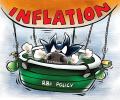
The Indian government has extended the Reserve Bank of India's (RBI) mandate to maintain retail inflation at 4 per cent, with a tolerance band of 2 per cent on either side, for another five years until March 2031.

Finance Minister Nirmala Sitharaman's biggest challenge will be to find a new growth driver, particularly against the backdrop of a global economy ravaged by heightened uncertainty and fragmentation, financial markets on a precipice, and global commodity prices on a continued uptrend.

The Indian IPO market is experiencing a significant surge in preliminary filings, with 38 companies submitting papers to SEBI in March 2026, driven by a combination of improved issuer confidence, strategic regulatory compliance, and private equity investors seeking exits amidst volatile market conditions.

Sustaining 8 per cent-plus growth rates is necessary if we are to reach high-income status by 2047, points out Amitabh Kant.

Large tariffs by the United States administration and elevated geopolitical risk have increased near-term global financial stability risks, and along with weather events pose downside risks to domestic growth, Reserve Bank of India (RBI) Governor Sanjay Malhotra said in the foreword to the Financial Stability Report released on Monday.

According to the Economic Survey 2026, the appropriate stance for 2026 is therefore one of strategic sobriety rather than defensive pessimism.
